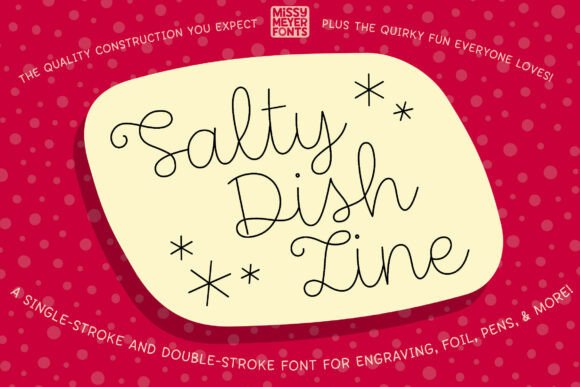
Salty Dish Line: The Hand-Drawn Font Built for Precision Drawing & Scoring
Imagine writing a heartfelt message on a wooden cutting board—fluid, organic, and unmistakably human. Or etching a name onto a delicate pendant with clean, confident strokes that mimic ink on paper. That’s the promise of Salty Dish Line: not just another script font, but a purpose-built single-line typeface engineered for tools that draw, score, engrave, and trace—not print.
More Than Just a “Handwritten” Look
Many fonts imitate handwriting. Salty Dish Line lives it—literally. It evolved from the original Salty Dish outline typeface, but stripped down to its essential gesture: one continuous path per character. No fills. No overlapping vectors. No hidden contours. Just smooth, rhythmic strokes that behave like real pen-on-paper movement.
This isn’t stylistic preference—it’s functional necessity. When your Glowforge scores a greeting card, your Cricut draws with a fine-tip stylus, or your Brother ScanNCut traces an engraved jewelry layout, the machine doesn’t interpret “artistic flair.” It follows vector paths. And if those paths are complex, layered, or misaligned, you get skipped lines, double-traced letters, or failed cuts. Salty Dish Line eliminates that risk by design.
Why Single-Line Fonts Matter in Today’s Creative Workflows
Modern makers don’t just print—they personalize, engrave, foil, infuse, and emboss. Whether you’re running a small-batch gift shop, designing custom wedding keepsakes, or crafting family heirlooms at home, your workflow likely includes:
- Sketch pens (like those used with Cricut Maker or Silhouette Cameo)
- Foil quills for metallic accents on cards and stationery
- Engraving tools for wood, leather, acrylic, or metal
- Infusible Ink pens for vibrant, permanent transfers on mugs and tote bags
- Glowforge scoring for subtle, elegant line art on coasters or signage
- Any stylus-based tool that moves along a defined path rather than filling shapes
In all these cases, traditional outline fonts fall short. They’re built for rendering on screens or inkjet printers—not for guiding physical tools across material surfaces. Salty Dish Line bridges that gap. Its clean, unbroken strokes translate reliably into motion commands your machine understands instantly.
Two Versions, One Purpose
Salty Dish Line ships with both single-stroke and double-stroke variants—not as stylistic options, but as practical adaptations. Why?
Some software interprets thin single lines as too fragile or invisible at small sizes. Others require slightly thicker strokes for consistent tool engagement, especially when using slower feed rates or softer materials like balsa or cork. The double-stroke version adds subtle weight without sacrificing the hand-drawn rhythm. It’s not bold—it’s *present*. You choose based on your machine, material, and desired outcome—not guesswork.
Real-World Use Cases Where Salty Dish Line Shines
You don’t need a studio to benefit from Salty Dish Line. Its strength lies in versatility grounded in realism:
- Greeting cards — Draw names and messages directly onto kraft paper or linen stock with a fine-point pen. The casual flow feels personal, not templated.
- Personalized gifts — Engrave “Est. 2024” onto a maple cheese board or “Always & Forever” onto a stainless steel flask. The script bends naturally around curves and corners.
- Engraved jewelry — Tiny pendants, minimalist rings, or birthstone charms gain warmth and intimacy with strokes that look drawn by hand—not laser-cut from a generic font library.
- Cutting boards & kitchenware — From olive wood charcuterie trays to bamboo spoons, Salty Dish Line adds artisanal charm without compromising legibility or toolpath reliability.
- Wedding signage & place cards — Score elegant names onto slate tiles or draw table numbers on vellum overlays. Consistent stroke width means no fading or thinning mid-letter.
Compatibility: Know Before You Cut
Even the best-designed font can hit roadblocks in software. Salty Dish Line is optimized for drawing workflows—but it respects real-world limitations. Here’s what to know:
Brother CanvasWorkspace
Typeable fonts sometimes render unpredictably in CanvasWorkspace due to how it handles vector imports. If characters appear distorted, disappear, or fail to convert cleanly, skip the TTF/OTF file entirely. Instead, use the included SVG file, which contains the full character set as ready-to-place vector paths. This gives you full manual control over spacing, alignment, and layering—ideal for precise layouts like monogrammed napkin rings or nested ring designs.
Cricut Design Space
A known issue may trigger an error when advancing to the “Make It” screen—especially with older versions of the app or certain browser configurations. If this happens, try these quick fixes:
- Ungroup and recombine text manually after converting to “flatten”
- Use the SVG import instead of typing directly
- Update Design Space to the latest version (web or app)
- Test with shorter phrases first—longer strings increase processing load
These aren’t flaws in Salty Dish Line; they’re reminders that creative software evolves faster than font standards. The inclusion of SVG support shows thoughtful preparation—not just for today’s tools, but tomorrow’s updates.
Choosing the Right Tool for Your Project
Before loading Salty Dish Line into your next project, ask yourself:
- What’s my output method? — If you’re scoring, drawing, or engraving, this font fits. If you’re printing PDFs or generating web graphics, stick with standard outline fonts.
- What’s my material? — Soft woods, leather, and thin metals respond beautifully to consistent stroke weight. For ultra-fine detail on glass or ceramic, test at 10–12 pt size first.
- What’s my tool’s minimum line width? — Some styli struggle below 0.1 mm. Check your machine specs—Salty Dish Line’s single-stroke version starts at ~0.15 mm, making it broadly compatible.
- Do I need full language support? — The font covers Latin-based alphabets, numerals, and common punctuation. It’s ideal for English, Spanish, French, German, and similar languages—but doesn’t include extended diacritics or non-Latin scripts.
There’s no universal “best” font—but for anyone who draws, traces, scores, or engraves words—not just prints them—Salty Dish Line delivers rare alignment between aesthetic intention and technical execution.
Final Thought: Tools Should Extend Your Hand, Not Replace It
Great lettering doesn’t shout. It invites. It breathes. It carries the quiet confidence of someone who took time to write something meaningful—not generate it. Salty Dish Line doesn’t simulate that feeling. It enables it. With every stroke, it reminds you that craftsmanship isn’t about perfection—it’s about presence. And whether you’re gifting a hand-engraved spoon or signing a child’s first birthday card, presence is exactly what people remember.